
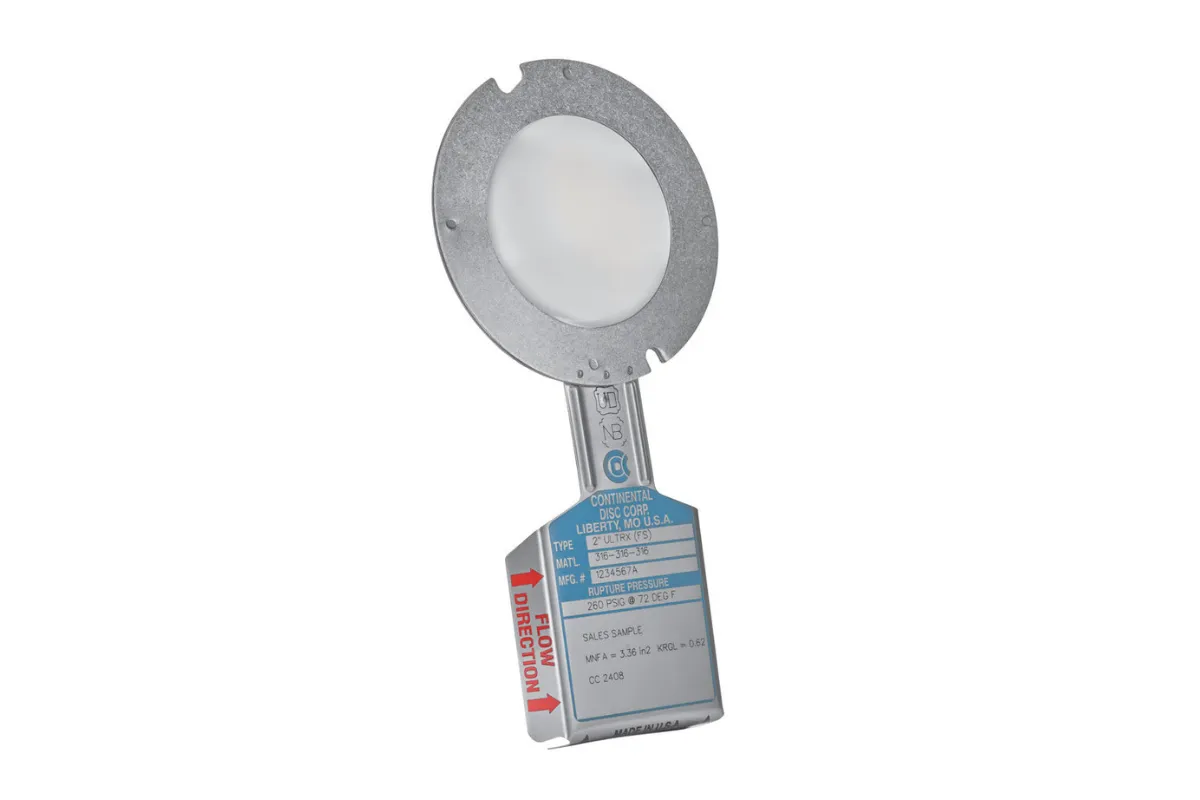
In short: the ULTRX™ is the scored reverse-acting disc that covers the highest burst pressures within the TRX family. It is chosen when the process needs a scored reverse-acting disc, but at pressures above what its lower-range siblings can handle.
How it works
Like every reverse-acting disc, the ULTRX™ is installed with the convex side of the dome facing the process. The pressure pushes the dome “head-on”, so the metal works in compression. While the pressure is below the burst value, the dome keeps its shape; on reaching the critical load, it loses stability, reverses suddenly and opens along the lines marked on its surface.
Two manufacturing details control this behavior. A calibrated indentation acts as the failure initiation point: it sets where the reversal begins and makes the disc behave repeatably from one piece to the next. The scoring defines where the metal tears once reversed, so that the opening is orderly. Because it works in compression rather than tension, this type of disc tends to tolerate pressure cycling better than a conventional disc, which reduces the risk of fatigue.
When it makes sense (and when it does not)
- Suitable when the required burst pressure is in the upper part of what the TRX family covers.
- Suitable in processes where pressure rises and falls frequently, whether in cyclic or pulsating regimes, in addition to static.
- Suitable when the fluid requires a special metal or alloy, because the manufacturer offers a wide selection of materials.
- Not suitable if the required pressure is low or medium: for those ranges the family itself offers the STAR X™ (ultra-low/low) and the MINTRX® (medium to low).
- Nor is it suitable if the pressure exceeds the ceiling of the TRX line; the manufacturer then refers to the HPX® family.
- Like any reverse-acting disc, it is sensitive to impacts or dents in the dome and must be installed in the correct orientation; a damaged dome can open at a pressure different from the marked one.
Data to specify it
- Burst pressure and the temperature at which it must be guaranteed.
- Maximum operating pressure and type of service (static, cyclic, pulsating), to verify the operating ratio.
- Fluid and phase, to select the disc material.
- Line size and available or required disc holder.
- If there is a possibility of vacuum or back pressure on the outlet side.
A practical tip: before settling on the ULTRX™, compare the burst pressure you need with the published ranges of the three TRX models. Choosing the model whose range fits with margin avoids working at the extreme end of a design's curve.
| Characteristic | According to the manufacturer |
|---|---|
| Family | TRX |
| Type | Reverse-acting, with scoring |
| Position in the family | Highest burst pressure range |
| Failure initiation | Calibrated indentation |
| Materials | Special metals and alloys |
| Service | Static, cyclic or pulsating |
To go deeper: How to select a rupture disc and Common rupture disc failures.
Descriptive sheet for educational purposes. For availability and a quote for this model, consult P&V Control Devices.