

Short answer: a rupture disc is a metal (or graphite) membrane calibrated to burst at a specific pressure and temperature. While the equipment pressure is below that value, it seals tightly; when it is exceeded, it opens in milliseconds and lets the fluid escape to protect the vessel, piping or valve behind it. It has no moving parts and is single-use.
By the P&V Control Devices technical team · Updated October 4, 2026 · Reading time: 7 min
Definition in one sentence
A rupture disc (also called a bursting disc) is a non-reclosing pressure relief device: a thin, formed and calibrated sheet that acts as the intentional weak link of a pressurized system. It is also known as a "rupture membrane", "burst disc" or, colloquially, a "pressure fuse", because it serves the same function as a fuse in an electrical circuit: it sacrifices itself so that the rest of the system does not fail.
Design codes classify it as a non-reclosing pressure relief device: once it opens, it stays open until it is replaced. That is the essential difference from a pressure relief valve or safety valve, which recloses when the pressure drops.
How it works
In short: the disc withstands the operating pressure like a taut membrane; on reaching the burst pressure, the material yields (by tension or by buckling, depending on the design) and a flow area practically equal to the line diameter opens.
- Normal operation. The disc is clamped between two flanges or inside a disc holder. Process pressure acts on one of its faces and the disc remains intact and hermetic: there is no leakage or fluid consumption.
- Overpressure. If a runaway reaction, an external fire, a regulator failure or a blocked discharge raises the pressure, the stress on the disc increases.
- Rupture. On reaching the marked burst pressure (within its tolerance), the disc opens. In forward-acting discs the dome stretches until it ruptures; in reverse-acting discs the dome reverses and opens along scored lines or knife blades.
- Discharge. The fluid exits to the atmosphere, a relief header, a flare or a collection tank. Equipment pressure drops and the vessel is protected.
- Replacement. The process is stopped, the cause is investigated and a new disc is installed. The used disc is not reused.
Opening is very fast (on the order of milliseconds), so the rupture disc is the preferred option when pressure can rise suddenly, for example in a deflagration or a runaway chemical reaction, cases in which a spring-loaded valve might not open in time.
Parts of a rupture disc device
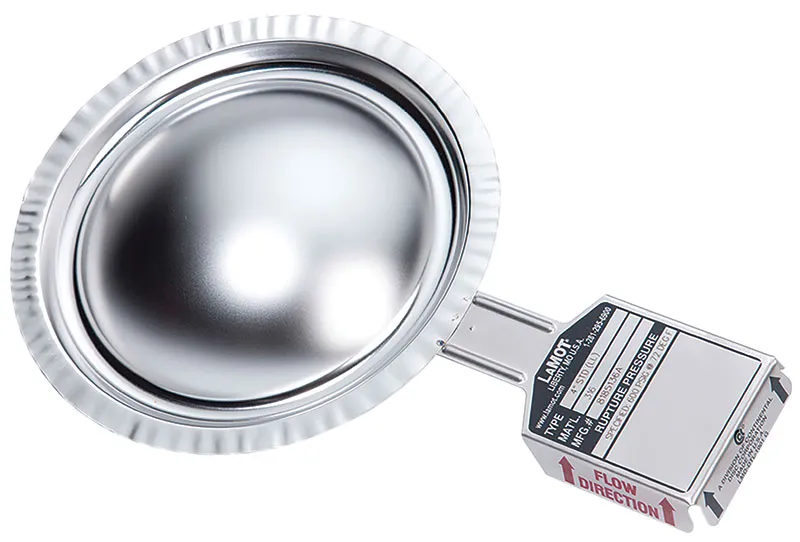
The codes refer to a "rupture disc device" because the disc almost never works alone. A typical assembly includes:
- Rupture disc: the calibrated membrane. It can be monolithic (a single sheet), composite (several layers, with a fluoropolymer seal) or graphite.
- Disc holder: the machined support that centers the disc, defines the seating area and ensures the clamping is the same as that with which the lot was tested. Types include insert (between flanges), full flanged, threaded and sanitary clamp-type holders.
- Vacuum or back pressure support: prevents the disc from collapsing when the process side goes into vacuum or when there is downstream pressure.
- Nameplate (tag): indicates burst pressure, coincident temperature, size, material, lot number and flow direction. It is the disc's "ID card" and must be kept.
- Optional accessories: burst sensor (alarm), pressure gauge or indicator between disc and valve, thermal protections.
What it is for and where it is used
Short answer: it prevents equipment from exceeding its maximum allowable working pressure (MAWP) and, in many cases, isolates a pressure relief valve from the process fluid.
Its most common applications are:
- Primary protection of reactors, vessels, heat exchangers, filters and piping.
- Pressure relief valve protection, installed upstream so that corrosive, viscous or polymerizing fluid does not reach the valve, and to eliminate seat leakage.
- Secondary protection or contingency protection for fire or runaway reaction scenarios.
- Sanitary processes (pharmaceutical, biotechnology, food and beverage), where designs without exposed scores and clamp-type connections that can be cleaned in place are used.
- Transport and storage: tankers, cylinders and tanks for liquefied gases.
- Oil and gas: separators, compressors, injection lines and downhole tools.
Advantages and limitations
| Advantages | Limitations |
|---|---|
| Fully hermetic: zero leakage until burst. | It does not reclose: after opening, the process loses containment until it is replaced. |
| Practically instantaneous response. | Sensitive to pressure cycling and to operating very close to its burst pressure. |
| No moving parts: it does not jam because of solids, polymers or crystals. | Its burst pressure depends on temperature; it must be specified at the actual disc temperature. |
| Large flow area in little space and at low initial cost. | Requires careful installation: incorrect torque or an inverted disc alters the opening pressure. |
| Available in exotic alloys (Hastelloy, tantalum, nickel) and graphite for highly corrosive fluids. | It is a consumable: its replacement must be scheduled. |
That is why it is common to combine it with a pressure relief valve: the disc provides tightness and corrosion protection, and the valve provides reclosing. We explain this in the guide rupture disc vs pressure relief valve.
Data that define a rupture disc
To specify or purchase a disc, at a minimum the following data are needed:
| Data | What it means |
|---|---|
| Marked burst pressure | Pressure at which the disc must open, at the specified temperature. |
| Coincident temperature | Disc temperature at the moment of rupture (not necessarily the process temperature). |
| Burst tolerance | Allowable variation around the marked pressure. |
| Operating pressure and operating ratio | How close to the burst pressure the disc will operate continuously. |
| Nominal size and disc holder type | Line diameter and clamping method (insert, flanged, threaded, sanitary). |
| Disc and disc holder material | It must be compatible with the fluid and the temperature. |
| Special conditions | Vacuum, back pressure, cycling, pulsations, liquid or gas service, need for a non-fragmenting disc. |
The detail of each criterion is in our guide how to select a rupture disc; the terms are defined in the glossary.
Frequently asked questions
Is a rupture disc the same as a safety membrane?
Yes. "Rupture membrane", "burst disc", "safety disc" and "bursting disc" refer to the same device. The ISO 4126-2 standard uses the term bursting disc safety device; ASME uses rupture disk device.
Can it be reused after bursting?
No. Bursting is a permanent deformation. In addition, a disc that was removed without bursting should not be reinstalled either if it was handled, because the seating surface has already been marked.
Does it protect against vacuum?
It can, if a double-direction disc or a vacuum relief device is specified. A standard disc only needs a vacuum support to avoid collapsing; that does not mean it relieves vacuum.
How long does a rupture disc last?
It depends on the operating ratio, cycling, temperature and corrosion. Many plants replace it at every scheduled shutdown; see the maintenance and replacement guide.
Do you need to specify or replace a disc?
This portal is educational. If you already have your equipment data (pressure, temperature, size and fluid), the P&V Control Devices team can review the application and quote the disc and its disc holder; their rupture disc catalog shows the available families.
Next reading: Types of rupture discs: forward-acting, reverse-acting, composite and graphite.