

Short answer: rupture discs are classified by the way they work under pressure. Forward-acting (tension-loaded) discs have the dome toward the discharge and burst by stretching; reverse-acting discs have the dome toward the process and open by reversing, which allows them to operate closer to their burst pressure. There are also composite discs (several layers with a fluoropolymer seal), flat discs for low pressure and graphite discs for highly corrosive media.
By the P&V Control Devices technical team · Updated on October 4, 2026 · Reading time: 8 min
The criterion that changes everything: which way the dome faces
Most metal discs are dome-shaped. That dome is formed by applying pressure to the flat sheet before calibrating it. What defines the type is which side the process pressure is on:
- If the pressure pushes on the concave face (the dome "points" toward the discharge), the metal works in tension: it is a forward-acting (tension-loaded) disc.
- If the pressure pushes on the convex face (the dome "points" toward the process), the metal works in compression and fails by instability, like a crushed can: this is a reverse-acting disc, also called reverse-acting / reverse buckling.
This difference determines the allowable operating ratio, cycling resistance, sensitivity to damage during installation, and whether the disc can be placed upstream of a pressure relief valve.
Forward-acting (tension-loaded) discs
In short: they are the classic design; simple, economical and available in a very wide pressure range, but they must operate with more margin relative to their burst pressure.
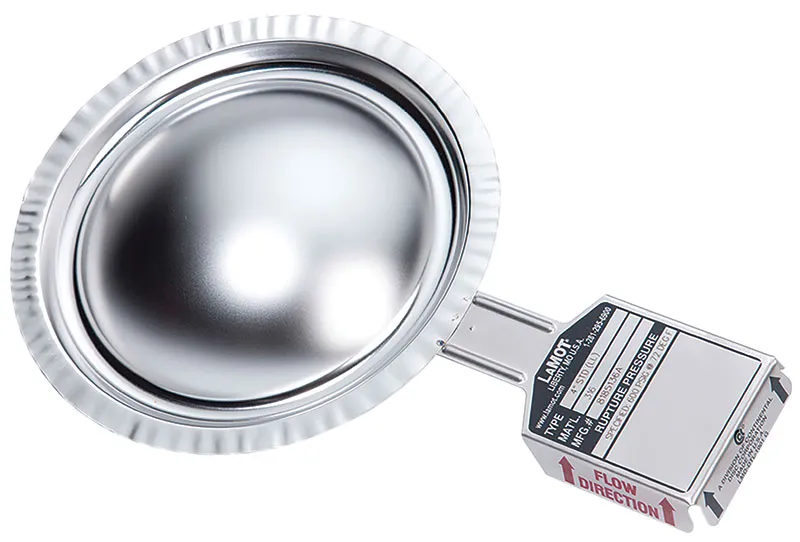
Solid forward-acting (tension-loaded, conventional)
An unscored metal dome that stretches until it ruptures at the center. It is robust and handles high pressures, but on rupture it tends to fragment, so it is not recommended upstream of a pressure relief valve. Its typical operating ratio is around 70 % of the marked burst pressure; above that the metal creeps and the disc may burst prematurely.
Forward-acting scored
The dome carries score lines (cross-shaped or circular) that define where it opens. This controls petal-type opening, makes it non-fragmenting and allows higher operating ratios, typically on the order of 80-85%. They are common in gas and liquid service with stable pressure.
Reverse-acting discs
In short: the dome snaps through all at once when pressure reaches the design value and opens against slots or knives. They tolerate operating up to about 90 % of their burst pressure and withstand cycling and pulsation very well.
Because the metal works in compression, the burst pressure depends mainly on the dome geometry rather than on thickness, which allows thicker material and, therefore, greater resistance to corrosion and fatigue. Common variants:
- Scored: the inverted dome opens along a partial circular score, leaving the petal attached by a "hinge". It is the most widespread design today.
- With knives: the disc, when it reverses, strikes knife blades located downstream that cut it. The condition of the blades must be monitored.
Precautions specific to this type: it must not be installed backwards (if the dome faces the discharge side it can open at a pressure far above the marked value) and it must not have dents in the dome, because any deformation lowers its buckling pressure. For this reason they are handled with care and used with disc holders that have pins or guides that prevent them from being mounted inverted.
In liquid service, some reverse-acting discs need a volume of trapped gas under the dome to reverse with enough energy; there are designs specifically certified for liquid. This is a point that must be confirmed when selecting.

Composite discs
In a nutshell: they combine a perforated or scored metal layer, which provides strength, with a fluoropolymer seal (PTFE, FEP or PFA) or another sheet that provides leak tightness and chemical resistance.
They allow low burst pressures in large sizes, and the seal can isolate the metal from the corrosive fluid. There are forward-acting versions with flat seat or angled seat (for example 30°), depending on the disc holder. Their operating ratio is typically around 80 %, and the maximum temperature is limited by the seal material.
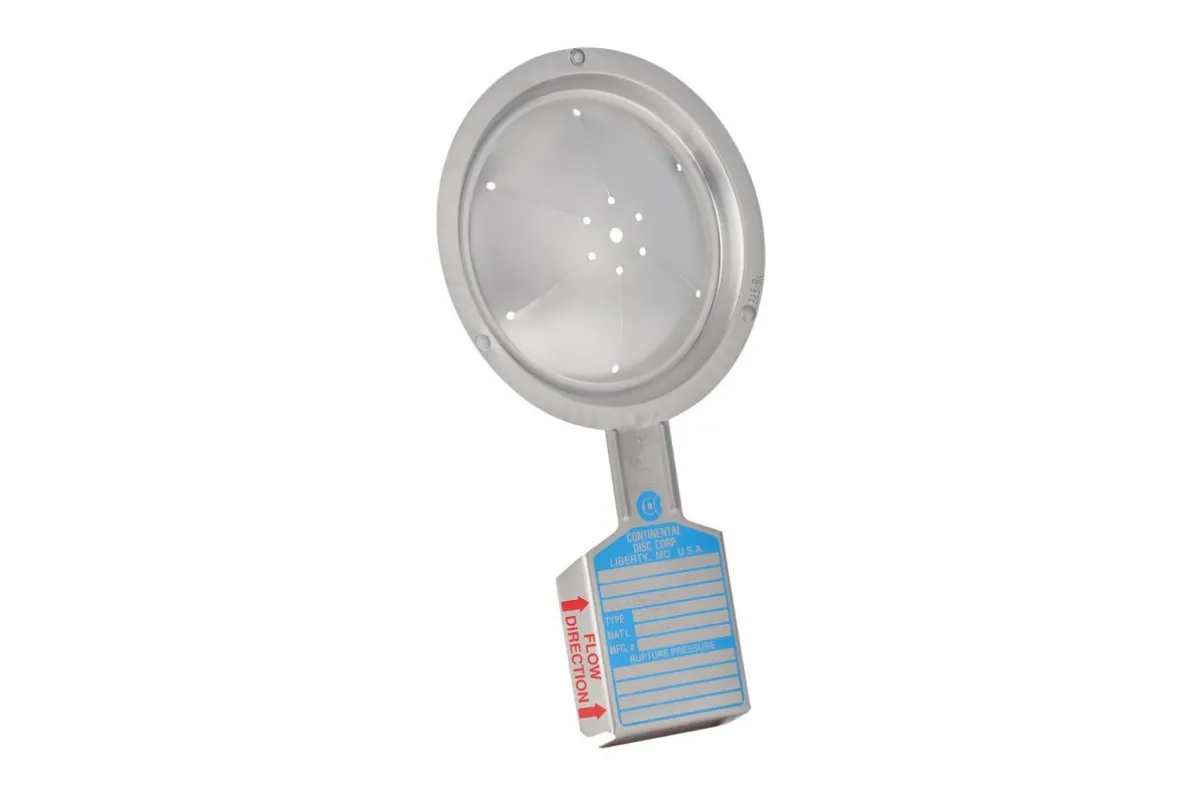
Flat discs
Domeless sheets, often composite or scored, intended for very low pressures: vents on silos, filters, dust collectors, atmospheric tanks and isolation seals. Some are used as an environmental or anticorrosive barrier at the outlet of a pressure relief valve, so that moisture or gases from the header do not attack it. Their operating ratio is lower and they usually require vacuum support if that condition exists.
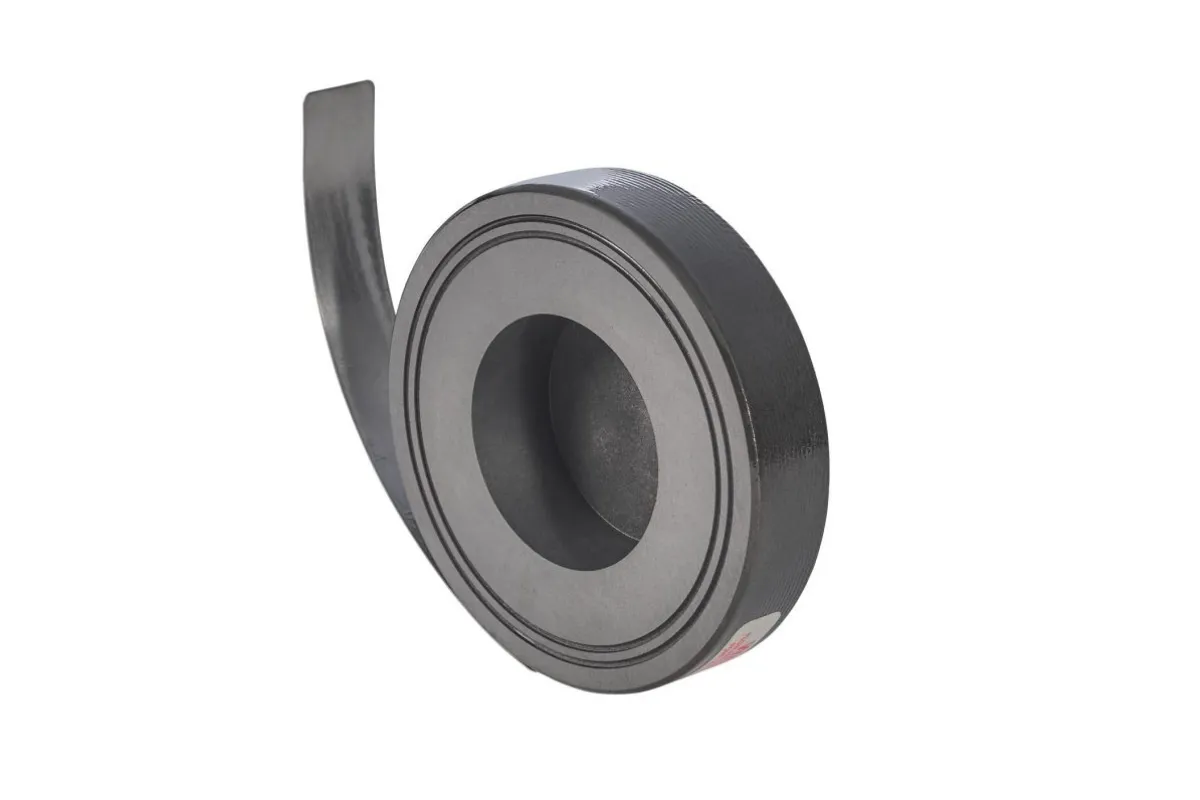
Graphite discs
In short: they are made of impregnated graphite (usually with resin) and are the economical alternative to exotic alloys when the fluid is highly aggressive: mineral acids, chlorides, halogenated media.
- They are brittle: on bursting they fragment, so they are not used upstream of a valve without a device that retains the fragments.
- They are not ductile: excessive tightening or a misaligned flange can crack them. They require controlled torque and suitable gaskets.
- Its burst pressure is only slightly sensitive to temperature within its range, but that range is set by the impregnation resin.
- In some designs they are fitted with a PTFE coating on the process face to improve chemical resistance.
Comparison table
The values are orders of magnitude that are usual in the industry; each manufacturer and model publishes its own, and those are the ones that govern.
| Type | Typical operating ratio | Cycling resistance | Does it fragment? | Typical use |
|---|---|---|---|---|
| Solid forward-acting | ≈ 70 % | Low | Yes | High pressure, discharge to atmosphere, stable pressure |
| Forward-acting scored | ≈ 80-85 % | Medium | No | Gases and liquids, stable or moderately cyclic pressure |
| Scored reverse-acting | Up to ≈ 90 % | High | No | Cyclic service, below pressure relief valves, sanitary processes |
| Composite | ≈ 80 % | Medium | Depends on design | Low pressure in large sizes, corrosive fluids |
| Flat | Low (consult) | Low | Depends on design | Very low-pressure vents, isolation seals |
| Graphite | ≈ 80-90 % depending on design | Medium | Yes | Acids and highly corrosive media |
Fragmenting and non-fragmenting
Short answer: a non-fragmenting disc opens into petals that remain attached to the ring; a fragmenting one releases pieces. If the disc is installed ahead of a pressure relief valve, ASME requires that it cannot damage the valve or obstruct its operation, which in practice means using a non-fragmenting disc (normally reverse-acting or scored forward-acting).
A non-fragmenting design is also advisable when the discharge goes to a shared header, to a recovery system, or when the pieces could damage downstream instruments.
Which one to choose?
- Pressure with cycling or pulsation, or narrow operating margin: reverse-acting.
- Stable pressure, no valve downstream and a tight budget: forward-acting.
- Very low pressure in large diameter: composite or flat.
- Strong acids where an exotic metal would be very costly: graphite, or metal with a fluoropolymer seal.
- Pharmaceutical and food industry: sanitary reverse-acting designs with clamp connection (see sanitary rupture discs).
The complete process, with the data to gather, is in how to select a rupture disc.
If you want to compare specific models, P&V Control Devices has a section of reverse-acting rupture discs (and forward-acting) where you can review families and request a quote.
Related guides: What a rupture disc is · Installation and disc holders · Glossary