
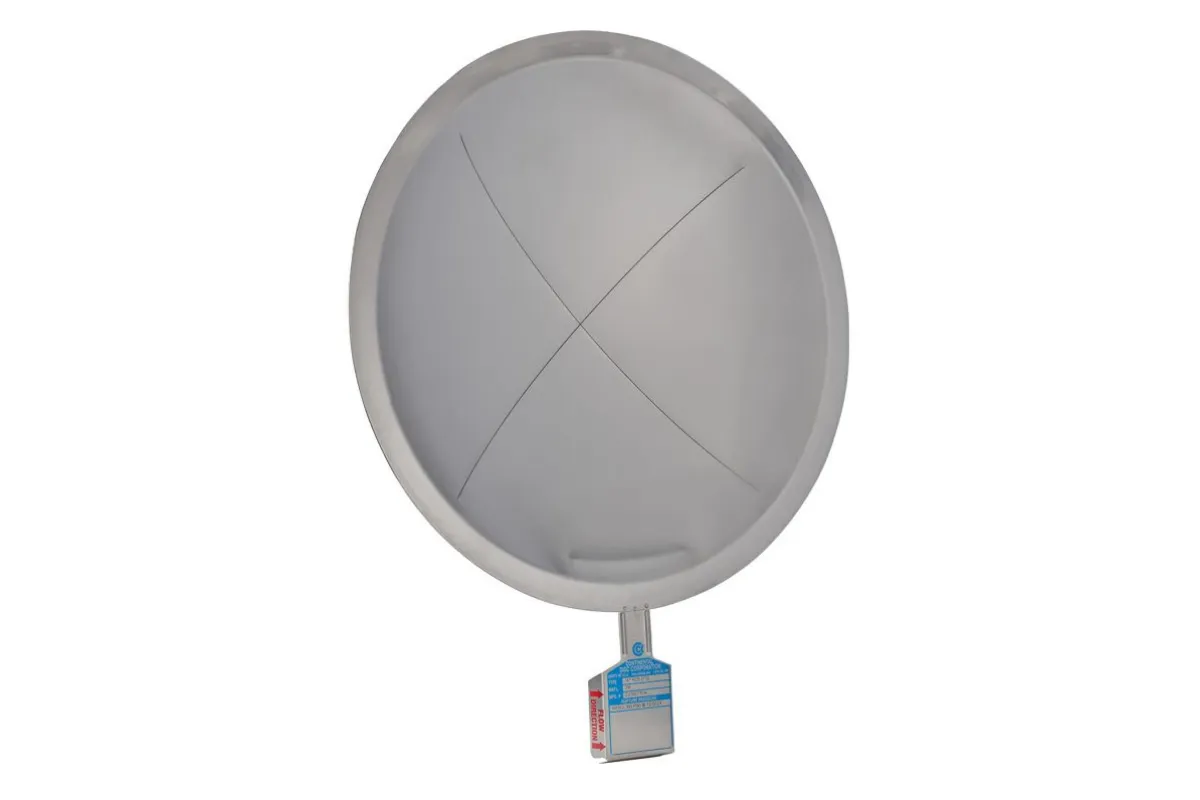
In short: The RCS® is a reverse-acting rupture disc with cross cuts and calibrated indentations that cause failure at low pressures. It is intended for corrosive or fouling-prone processes, because its cuts are on the vent side and it accepts fluoropolymer coatings.
How it works
Like every reverse-acting disc, the RCS® presents its convex dome toward the process. While the pressure is below the trip point, the dome resists in compression; on reaching it, it collapses, reverses and opens. In this model the opening follows a series of cross cuts that divide the disc into sectors, and precision indentations set the point where the reversal begins. That combination is what allows accurate operation at low burst pressures.
An important practical detail: the cuts are made on the vent face, not on the process face. The surface that sees the fluid is left without grooves where product could accumulate or where corrosion could advance faster than in the rest of the metal. This helps keep the burst pressure from drifting over time and lets the disc withstand pressure and temperature cycles.
The manufacturer also highlights the use of thicker material and the option of a fluoropolymer lining or coating, both measures aimed at chemical resistance.
When it makes sense (and when it does not)
- Suitable in corrosive services or with solids, polymers or crystals that could lodge in process-side scores.
- It is suitable when a low burst pressure with good repeatability is needed and a metallic reverse-acting disc is preferred.
- Suitable for expansions or replacements, since the manufacturer presents it as easy to integrate into existing piping.
- Caution with the coating: a fluoropolymer improves chemical resistance, but it has its own temperature limits that must be checked.
- Not the obvious choice if the service is clean and non-corrosive and a conventional disc is enough; the advantages of the RCS® are mainly realized in aggressive media.
Data to specify it
- Nominal size and disc holder it will be installed in.
- Burst pressure and coincident temperature.
- Fluid composition, contaminants and tendency to foul.
- Base material and whether a fluoropolymer lining is required.
- Operating profile: normal pressure, cycles and possible vacuum.
| Type | Reverse-acting with cross scores |
|---|---|
| Failure initiation | Precision indentations |
| Score location | Vent side |
| Chemical protection | Thicker material; fluoropolymer option |
Learn more: Rupture disc materials and Common rupture disc failures.
Descriptive sheet for educational purposes. For availability and a quote for this model, consult P&V Control Devices.