
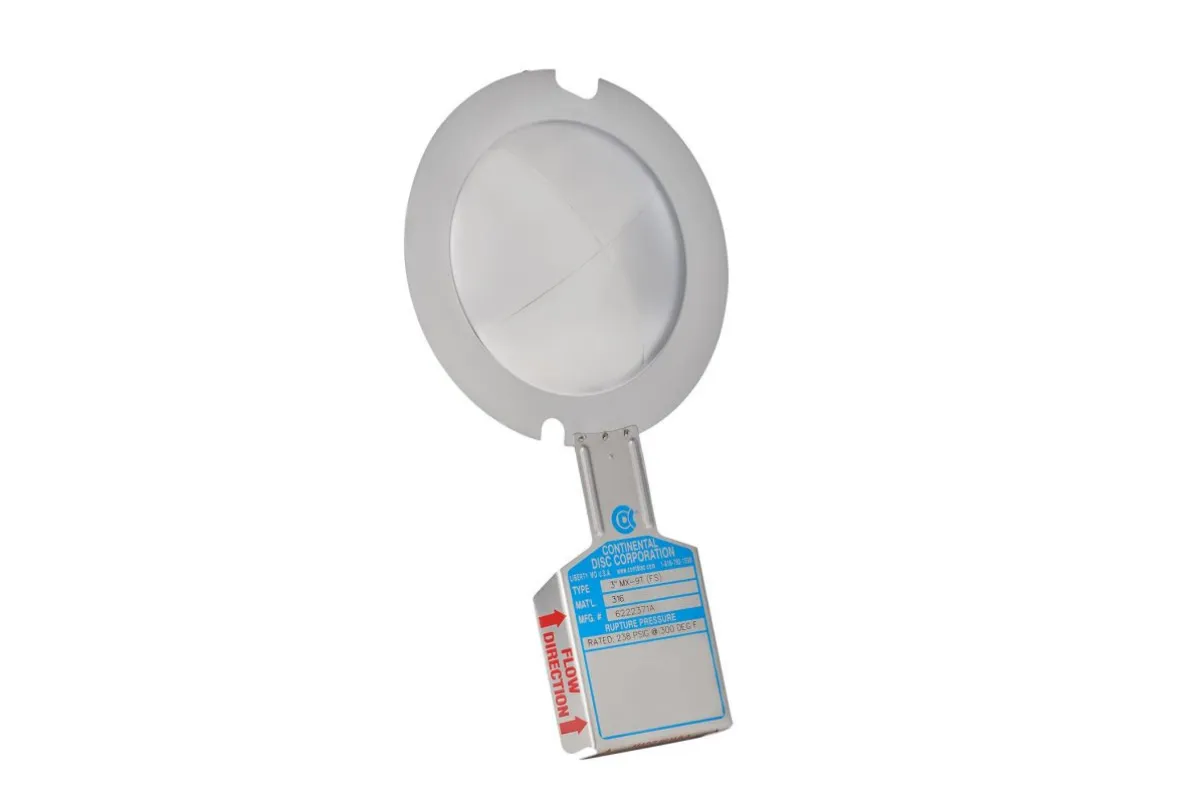
In short: The MICRO X™ is a tension-loaded, flat-seat rupture disc with a cross mark that opens into four petals without releasing fragments. It mounts in the UNISERT assembly and has a completely smooth process face, which makes it useful in corrosive or buildup-prone services.
How it works
In a forward-acting disc the process pressure acts on the concave face and stretches the material until it yields. In the MICRO X™ that yield point is not left to chance: a cross-shaped score weakens the disc along two perpendicular lines, so that on bursting four petals form, fold back toward the vent and remain attached to the rim. Opening is full and non-fragmenting, meaning no pieces of metal leave with the flow.
What is particular about this model is where that marking is made: only on the vent face. The face that touches the fluid has no scores, so there are no grooves where product can lodge or where corrosion can concentrate its attack. In practice, this helps the burst pressure remain stable for longer in aggressive media.
The disc is designed for the UNISERT assembly, which, according to the manufacturer, is installed without modifying the existing flanges, simplifying both the initial installation and replacements.
When it makes sense (and when it does not)
- Suitable for corrosive processes or products that tend to stick, where a smooth surface on the process side makes the difference.
- Suitable when there is particle-sensitive equipment downstream, such as a pressure relief valve, thanks to its non-fragmenting opening.
- It is suitable for services with cleanliness requirements or where low maintenance is sought.
- Recommended if the plant already uses UNISERT assemblies or needs to install the disc without modifying the existing flanges.
- Check whether there is vacuum or back pressure: forward-acting discs usually need support so they do not collapse.
- Check whether the operating pressure comes very close to the burst pressure or there are strong pulsations; in that case, compare with a reverse-acting disc.
Data to specify it
- Line size and flanges where the UNISERT assembly will be housed.
- Burst pressure and coincident temperature.
- Process fluid and its tendency to corrode or foul.
- Normal operating pressure, cycles and possible vacuum.
- Disc material.
| Type | Tension-loaded, flat seat |
|---|---|
| Opening | Four petals, full opening and non-fragmenting |
| Marking | Cross-shaped, only on the vent side |
| Process side | Smooth, no scores |
| Mounting | UNISERT assembly |
To go deeper: Installation and disc holders and How to select a rupture disc.
Descriptive sheet for educational purposes. For availability and a quote for this model, consult P&V Control Devices.