
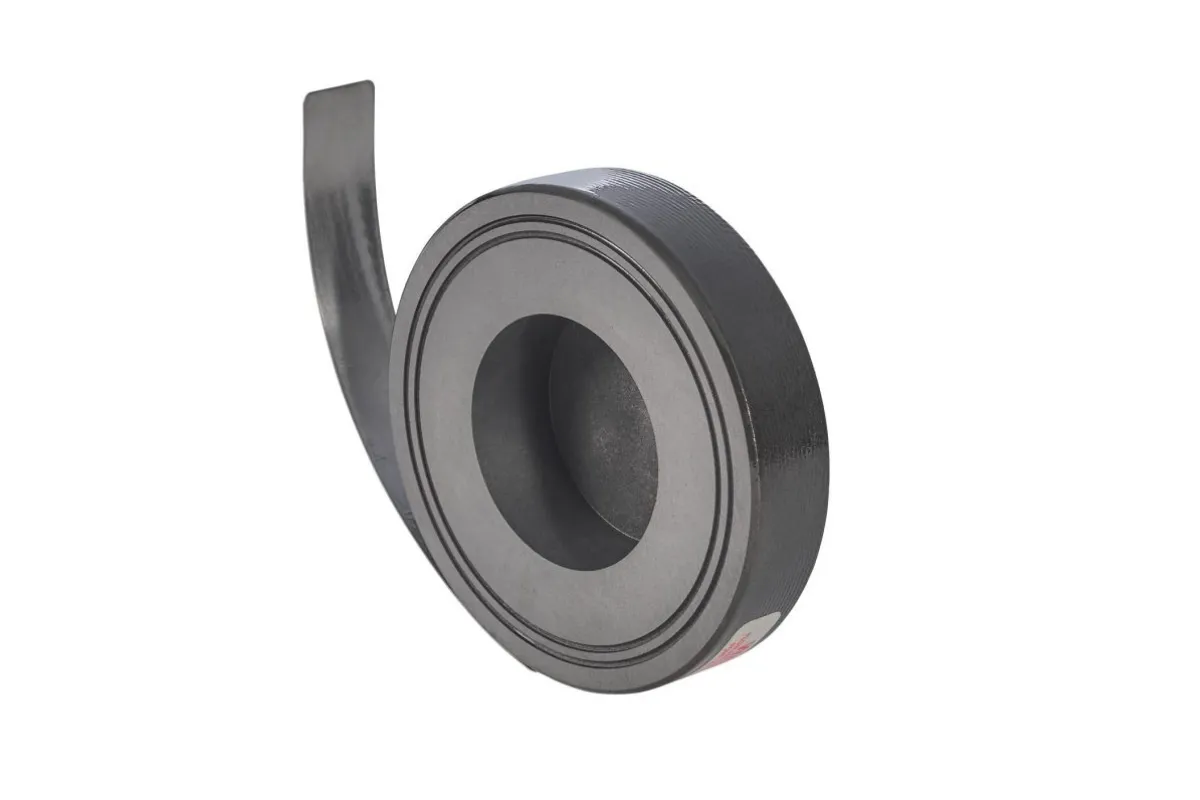
In short: The GRAFSERT is a graphite rupture disc: a solid sheet impregnated with phenolic resin that forms a single piece. It is used where metals suffer from corrosion and where it is desirable to intervene on the equipment as little as possible.
How it works
Unlike a pre-bulged metal disc, which stretches or reverses before opening, a graphite disc is flat and brittle: when the differential pressure exceeds its strength, it fractures by bending and shear in the working zone. Impregnation with phenolic resin seals the natural porosity of the graphite, makes it impermeable to the fluid and gives it the rigidity needed to burst repeatably.
The GRAFSERT is monolithic, meaning it has no joints or internal seams between parts that could be attacked by the medium. The manufacturer describes it as unidirectional, which means it is calibrated to burst with pressure applied in one specific direction and must be installed with the correct orientation.
As for the operating margin, the manufacturer indicates an operating/burst ratio of up to 80 % in static service. The operating ratio compares normal operating pressure with the marked burst pressure: the higher it is, the closer the equipment can operate to its relief point without fatiguing the disc.
When it makes sense (and when it does not)
- Suitable with highly aggressive chemical media where even special alloys have a short life or a high cost.
- It is suitable for remote or hard-to-reach installations, where every maintenance visit is costly.
- Suitable for static service with stable operating pressure.
- Not suitable if there are marked pulsations or cycles: the declared 80 % applies to static conditions.
- Caution downstream: graphite breaks into fragments, so it is not the right disc to install below a pressure relief valve without evaluating it first.
- Caution during installation: graphite does not tolerate excessive tightening torque or misaligned flanges well.
Data to specify it
- Nominal size and flange type.
- Burst pressure and service temperature.
- Fluid and concentration, to confirm compatibility with graphite and phenolic resin.
- Operating pressure and whether there is vacuum or back pressure.
- Direction of relief flow.
| Material | Solid graphite sheet impregnated with phenolic resin |
|---|---|
| Construction | Monolithic, with no gaskets or joints |
| Direction of action | Unidirectional |
| Operating/burst ratio | Up to 80 % in static service (according to the manufacturer) |
To learn more: Materials for rupture discs and Rupture disc glossary.
Descriptive sheet for educational purposes. For availability and a quote for this model, consult P&V Control Devices.