
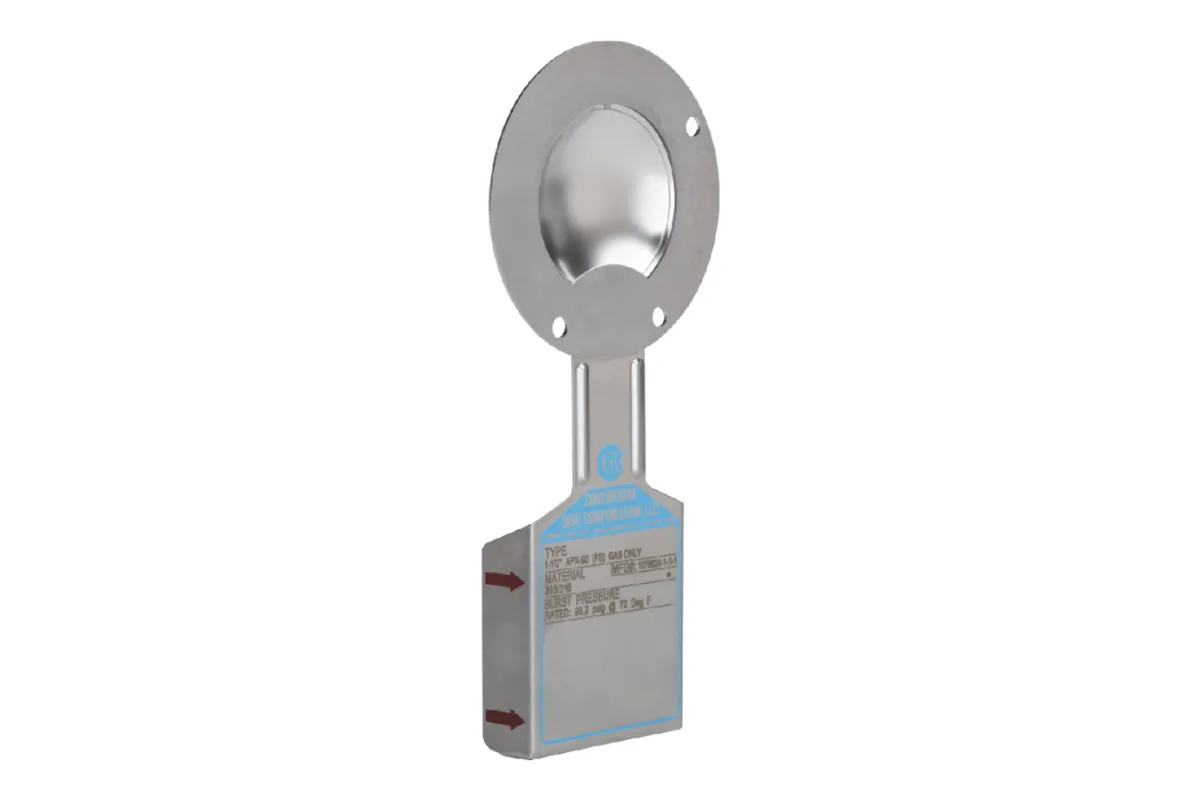
In short: the APX™ is a semicircular, scored, reverse-acting disc from Continental Disc Corporation, presented as the successor to the HPX®. It is aimed at systems with liquids, gases or steam that are also toxic or corrosive, and the manufacturer highlights its low Kr factors and its resistance to pressure cycling.
How it works
As with other reverse-acting discs, the dome is installed with its convex side toward the process, carries the pressure in compression and, when the pressure reaches the burst value, it reverses and opens along the score line, with a portion acting as a hinge that retains the petal. This mode of operation is what generally gives reverse-acting discs good fatigue tolerance when pressure rises and falls.
It is worth understanding what the Kr factor means, because it is the figure the manufacturer emphasizes. Kr is the flow resistance coefficient of the disc once open: it expresses how much head loss the disc adds when the relief system is analyzed as a piping run. A low Kr indicates that the open disc obstructs the flow very little, which helps the relief line discharge the required flow rate. This value is used in the system flow resistance sizing method, so it is useful to request it certified for the specific size.
With toxic media, the design matters for another reason: while the disc is closed it must be leak-tight, and when it opens it does so without shedding loose fragments that could damage downstream equipment.
When it makes sense (and when it does not)
- Recommended for services with toxic or corrosive fluids, where a leak or premature failure of the disc has serious consequences.
- Suitable for processes with many pressure cycles.
- Suitable when the relief line calculation is tight and a low Kr helps meet the required capacity.
- Check the material: «corrosive» is very broad. For halogens and highly aggressive acids the family offers a tantalum version (HPX-Ta™).
- It is not the right model for hygienic processes, which have their own line with sanitary connections.
Data to specify it
- Burst pressure and coincident temperature.
- Operating pressure and cycle frequency.
- Fluid, concentration and degree of toxicity, to choose material and gaskets.
- Diameter and disc holder; if replacing an HPX®, confirm compatibility with the existing disc holder.
- Certified Kr value for the chosen size, if the line will be sized by flow resistance.
- Quality documentation and traceability required by the project.
| Characteristic | According to the manufacturer |
|---|---|
| Type | Semicircular, scored, reverse-acting |
| Fluids | Liquids, gases or steam; toxic and corrosive |
| Kr factor | Low (certified value by size: request it from the manufacturer) |
| Maximum recommended operating ratio | 90 % or 95 % of the marked burst pressure |
| Sizes | 1" to 8" (25 to 200 mm) |
| Burst pressure | 10 to 600 psig (0.689 to 41.37 barg) |
| Disc materials | Nickel, alloy 400, 316 / 316L, alloy C276, alloy 600 |
| ASME stamp | Available |
| Pressure cycles | High resistance |
| Manufacturer | Continental Disc Corporation |
Values published by Continental Disc Corporation at contdisc.com (accessed: October 4, 2026).
To learn more: Relief area calculation according to API 520 and ASME VIII, ISO 4126 and API 520 standards.
Descriptive sheet for educational purposes. For availability and a quote for this model, consult P&V Control Devices.