
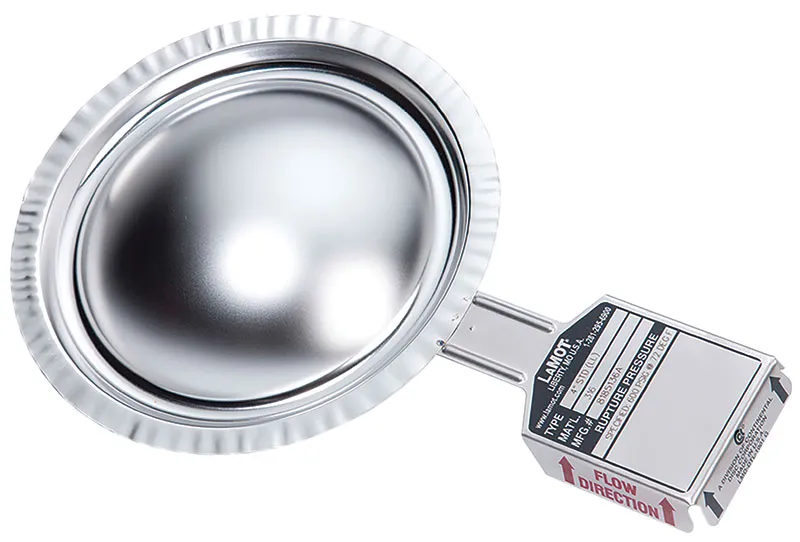
In short: The STD is the conventional solid-metal, pre-bulged rupture disc that works in tension and opens fully when its differential burst pressure is exceeded. It is the base model, and includes versions with an LL seat for insert-type disc holders; for threaded or disposable disc holders there is a dedicated STD variant.
How it works
The disc is manufactured from a metal sheet with no scores or markings, which is given a dome shape in the calibration process itself. It is installed with the concave face toward the process: pressure stretches the metal and, when the differential between the two sides reaches the design value, the dome thins at the crown and ruptures, leaving the path open. Being a single piece of metal, it has no moving parts or soft seals, and while it is not acting it keeps the system closed.
What matters is the differential pressure, not the absolute pressure. If there is back-pressure on the vent side, the process pressure at which the disc bursts rises by that same amount; therefore it is advisable to check what is downstream.
The manufacturer states that the STD tolerates static, pulsating and cyclic service. However, if the equipment can reach full vacuum or strong negative pressure fluctuations, it recommends adding a vacuum support, because a tension-loaded dome tends to reverse when pressure is applied from the convex side.
A practical detail: the disc carries a highly visible flow direction tag. On versions with an LL seat for insert disc holders the tag comes integrated; on other LaMOT models it is supplied separately and attached on site. An STD installed backwards will not protect the equipment at the intended pressure.
When it makes sense (and when it does not)
- It is suitable as general protection for tanks, piping, heat exchangers and reactors where a simple, proven device is sought.
- It is suitable for corrosive processes, choosing the right alloy (stainless steel, Hastelloy®, Inconel®, among others).
- Suitable in sectors such as chemical, petrochemical, pharmaceutical and food, depending on the application.
- Check whether vacuum is present: the vacuum support is not optional when full vacuum is expected.
- It is not the best option beneath a pressure relief valve if guaranteed opening without fragments is required; in that case, evaluate non-fragmenting designs.
- If the disc holder is threaded or disposable, the recommended version is the STD for screw-type holders.
Data to specify it
- Nominal size and type of disc holder (LL seat or other).
- Burst pressure and coincident temperature.
- Operating pressure, type of service (static, pulsating, cyclic) and possible vacuum.
- Back pressure on the vent side.
- Disc material according to the fluid.
Learn more: Types of rupture discs and Installation and disc holders.
Descriptive sheet for educational purposes. For availability and a quote for this model, consult P&V Control Devices.