
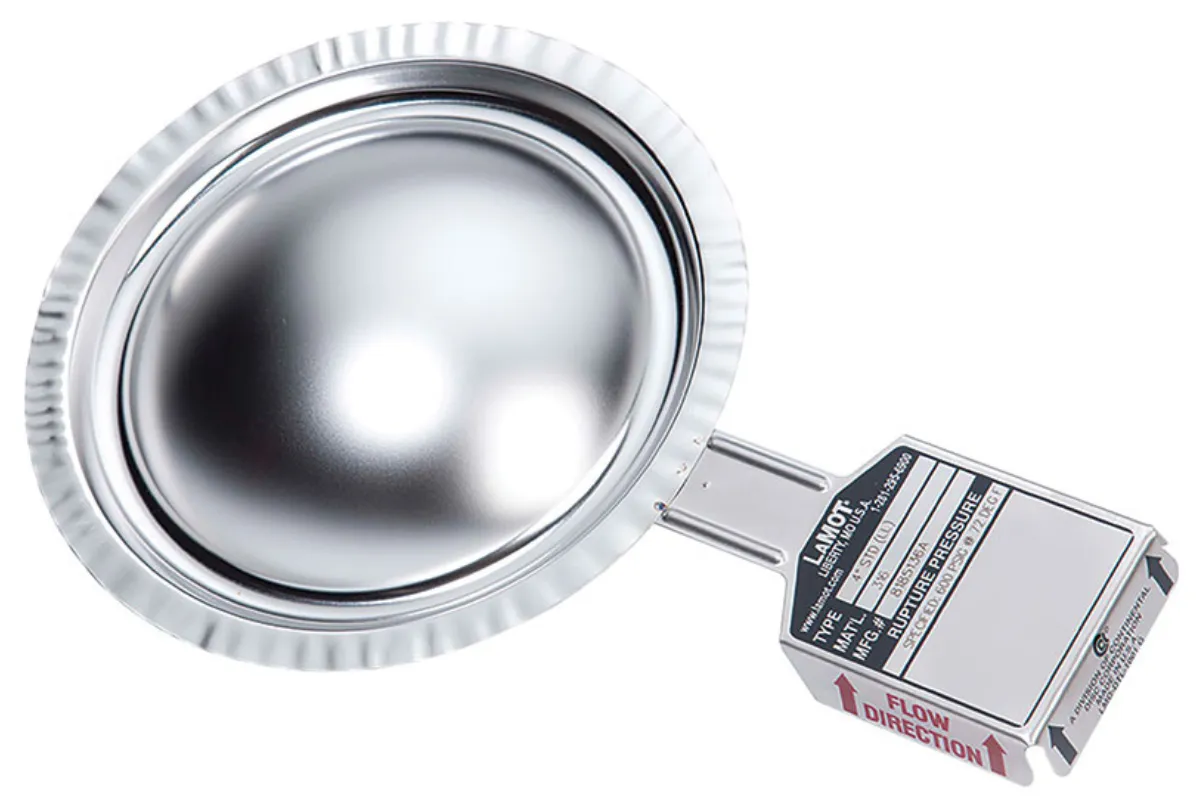
In short: The LDV is the LD composite disc with a vacuum support built into the process side. It retains the scored metal dome and the fluoropolymer or metal seal, and is intended for equipment that, in addition to being pressurized, may be left under full vacuum.
How it works
Every domed disc works well when pressure pushes in the direction it was designed for. The problem appears when the equipment is emptied, cooled or connected to a vacuum pump: the pressure difference reverses and tends to collapse the dome. In a composite disc, with scored metal and a thin seal, that load can deform the assembly and alter its burst pressure. The LDV vacuum support is a part that backs the dome precisely against that reverse load.
Otherwise, the principle is that of the LD. The metal top section sets the burst pressure; the seal, fluoropolymer or metallic, provides tightness and protects against corrosion and product buildup. The dome apex has seven holes and six pre-cut radial sections, which direct the opening and, with the right seal, prevent fragmentation. The manufacturer states an operating/burst ratio of up to 80 % and static, cyclic, or pulsating service.
When it makes sense (and when it does not)
- Suitable for vessels that alternate between positive pressure and vacuum, for example during emptying, cooling or cleaning.
- Suitable as primary or secondary relief with corrosive or fouling fluids.
- Suitable for isolating a safety valve; in a non-fragmenting version it helps control fugitive emissions.
- Unnecessary support if the system never drops below atmospheric pressure; a standard LD is simpler.
- Not suitable when normal operation is above 80 % of the nominal burst pressure.
Data to specify it
- Nominal burst pressure and coincident temperature.
- Maximum operating pressure and vacuum profile: partial or full, continuous or occasional.
- Back pressure at the discharge, if any.
- Seal material (fluoropolymer or metallic) according to fluid and temperature.
- Nominal diameter and disc holder.
- Non-fragmenting version requirement.
On diameters of 1" (25 mm) and above, the flow direction tag makes it easier to orient the disc and verify it during inspections.
| Characteristic | LD | LDV |
|---|---|---|
| Upper section | Scored metal | Scored metal |
| Seal | Fluoropolymer or metal | Fluoropolymer or metal |
| Vacuum support | Additional, on request | Built in on the process side |
| Operating ratio | Up to 80 % | Up to 80 % |
| Service | Static, cyclic or pulsating | Static, cyclic or pulsating |
To go deeper: How to select a rupture disc and Common rupture disc failures.
Descriptive sheet for educational purposes. For availability and a quote for this model, consult P&V Control Devices.