
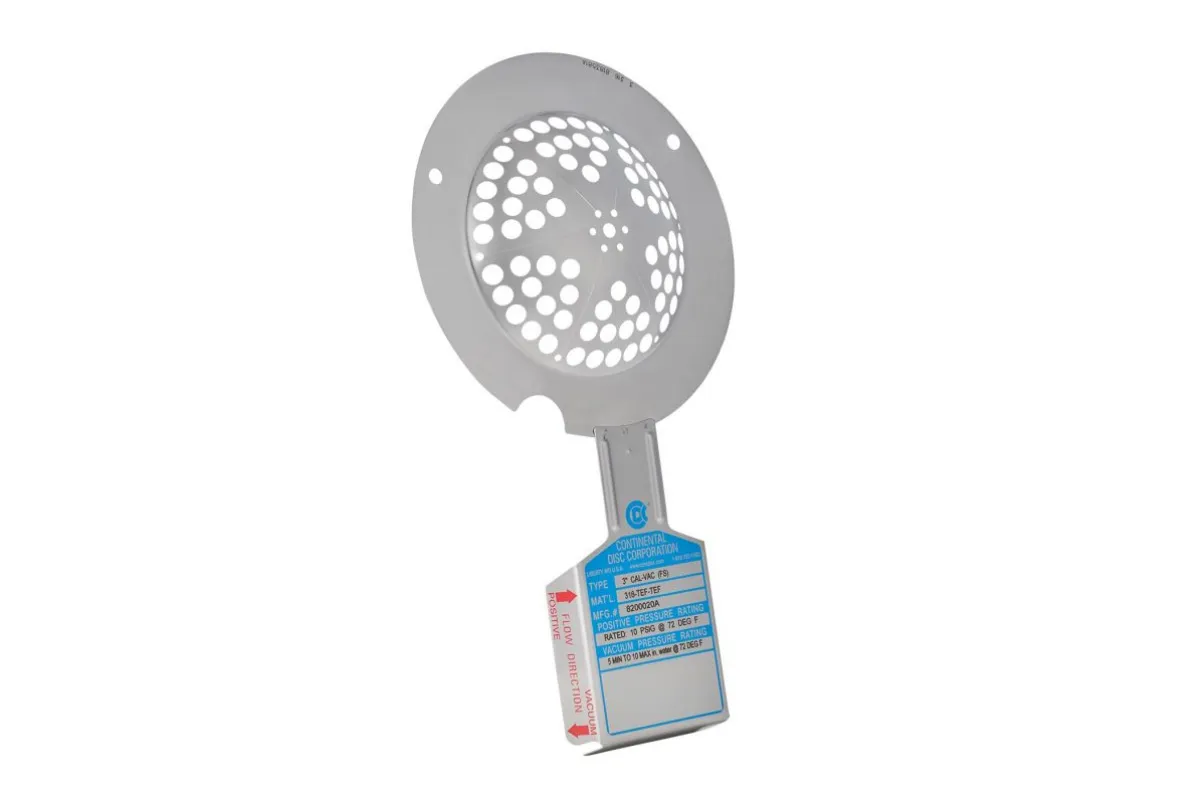
In short: the CAL-VAC® is a bidirectional, double-acting rupture disc: at a single installation point it relieves ultra-low vacuum (from 1 inWC) on one side and low positive pressure on the other. It is designed for process and storage tanks that can collapse under vacuum or burst from overpressure.
What problem it solves
A thin-walled tank can usually tolerate very little differential pressure in either direction. Vacuum is generated when a pump empties the tank faster than air enters, when a hot vapor condenses as it cools (flash vacuum) or after steam cleaning. Overpressure is generated by overfilling or by an external fire. Normally each hazard requires its own device; the CAL-VAC covers both with a single nozzle.
How it works
- Vacuum side (the most sensitive): when system vacuum approaches the set pressure, it loads a girdle (girdle) that deflects and passes through a knife-blade assembly mounted on the disc holder. The blade cuts the seal in a triangular pattern and the vacuum is relieved.
- Positive pressure side: a perforated metal top section works in tension and opens in the opposite direction. It has the seven-hole pattern at the apex of the dome and six pre-scored sections, which makes the opening non-fragmenting.
- It has no moving parts: calibration is in the geometry of the disc and the disc holder.
Its counterpart is the POS-A-SET®, which reverses the logic: it is more sensitive on the positive-pressure side.
Manufacturer data
| Characteristic | Value published by Continental Disc Corporation |
|---|---|
| Nominal sizes | 3" to 12" (80 to 300 mm) |
| Positive burst pressure | 2 to 150 psig (0.138 to 10.3 barg) |
| Burst vacuum | 1 to 115 inWC (inches of water column) |
| Seat | Flat |
| Service | Liquid or gas |
| Design | Bidirectional, double-acting, non-fragmenting, no moving parts |
| Materials | Special design for each application |
| ASME stamp | Not available |
| Sanitary use | Can be manufactured to meet 3-A with sanitary-connection disc holders |
| Alarm | Compatible with BDI burst alarm system |
Source: CAL-VAC® datasheet at contdisc.com, consulted on October 4, 2026.
When it makes sense (and when it does not)
- Suitable for atmospheric or low-pressure tanks in food, beverage and chemical plants that need very sensitive vacuum protection as well as overpressure protection.
- Suitable when there is little space or few nozzles available on the tank.
- Suitable for hygienic processes, with the sanitary disc holder version.
- Not the option if the vessel must carry a device with an ASME stamp: this model does not offer it.
- Not the right choice if the dominant risk is a medium- or high-pressure overpressure; in that case a conventional pressure disc is used and, if needed, a separate vacuum relief.
Data to specify it
- Maximum vacuum the tank tolerates (in inWC or mbar) and maximum positive pressure.
- Scenarios that generate vacuum and overpressure, with their relief flow rate.
- Nozzle size (between 3" and 12").
- Fluid and material or food-contact requirements.
- Connection type (flanged or sanitary) and whether a burst alarm is required.
Learn more: Sanitary rupture discs and How to select a rupture disc.
Descriptive sheet for educational purposes. For availability and a quote for this model, consult P&V Control Devices.